Amazon Sponsored Brands video can put a product demonstration directly into Amazon shopping results, but a polished video is not enough. If the promoted ASIN has weak retail readiness, the creative does not make sense without sound, or the campaign is optimized around attributed sales without checking new-customer economics, more visibility can simply accelerate inefficient spend.
For US marketplace sellers, the practical takeaway is to audit four connected layers before increasing budget: the product and destination, the video itself, targeting, and measurement. This article separates Amazon’s documented platform features from recommendations. Platform facts were reviewed on November 24, 2026; recommendations are operating guidance, not guarantees.
What Sponsored Brands video currently does
Amazon’s current Sponsored Brands guide describes video as one of three Sponsored Brands formats, alongside product collection and Brand Store spotlight. Sponsored Brands video can appear in shopping results and uses its own placement and auction. Eligible advertisers include sellers enrolled in Amazon Brand Registry, vendors and agencies.
Amazon’s video specifications describe two destination types: a product detail page or a Brand Store. Video ads can use keyword, category or product targeting and can appear in shopping results or on product detail pages. Videos autoplay when at least half of the pixels are on-screen, and they start muted.
These are platform capabilities, not evidence that every eligible product should use the format.
1. Choose the campaign’s commercial job
Recommendation: assign one primary job before producing creative.
A product-detail-page campaign is usually the clearer choice when one ASIN has a strong demonstration, adequate inventory, competitive pricing and a detail page ready to convert. A Brand Store destination can make more sense when the video introduces a product family, use-case range or brand story that cannot be completed on one detail page.
For example, a US reusable-bottle brand might send a product-focused video to one insulated-bottle ASIN. A video comparing commuting, gym and outdoor uses may be better suited to a Brand Store page that organizes those collections.
Write the destination and primary outcome into the brief. “Increase Amazon sales” is too broad. A more useful goal might be “acquire first-time purchasers for the insulated collection at an acceptable contribution margin.”
2. Audit the product and destination before the video
Video cannot repair an unavailable product or an unclear page. Before launch, confirm:
- the promoted ASIN is eligible, in stock and able to ship throughout the US marketplace;
- the title, images, bullets, price and variation structure match the video’s promise;
- reviews and questions do not reveal an unresolved expectation problem;
- the Brand Store page or product detail page works on mobile;
- the selected destination contains the products shown in the creative; and
- margin can support the target advertising cost after marketplace fees, fulfillment, discounts and returns.
Use the Amazon Sponsored Products audit to review search terms, bids and ASIN economics before moving an underperforming product into a richer ad format. Sponsored Brands video adds creative reach; it does not change the underlying retail economics.
3. Design for muted, fast shopping behavior
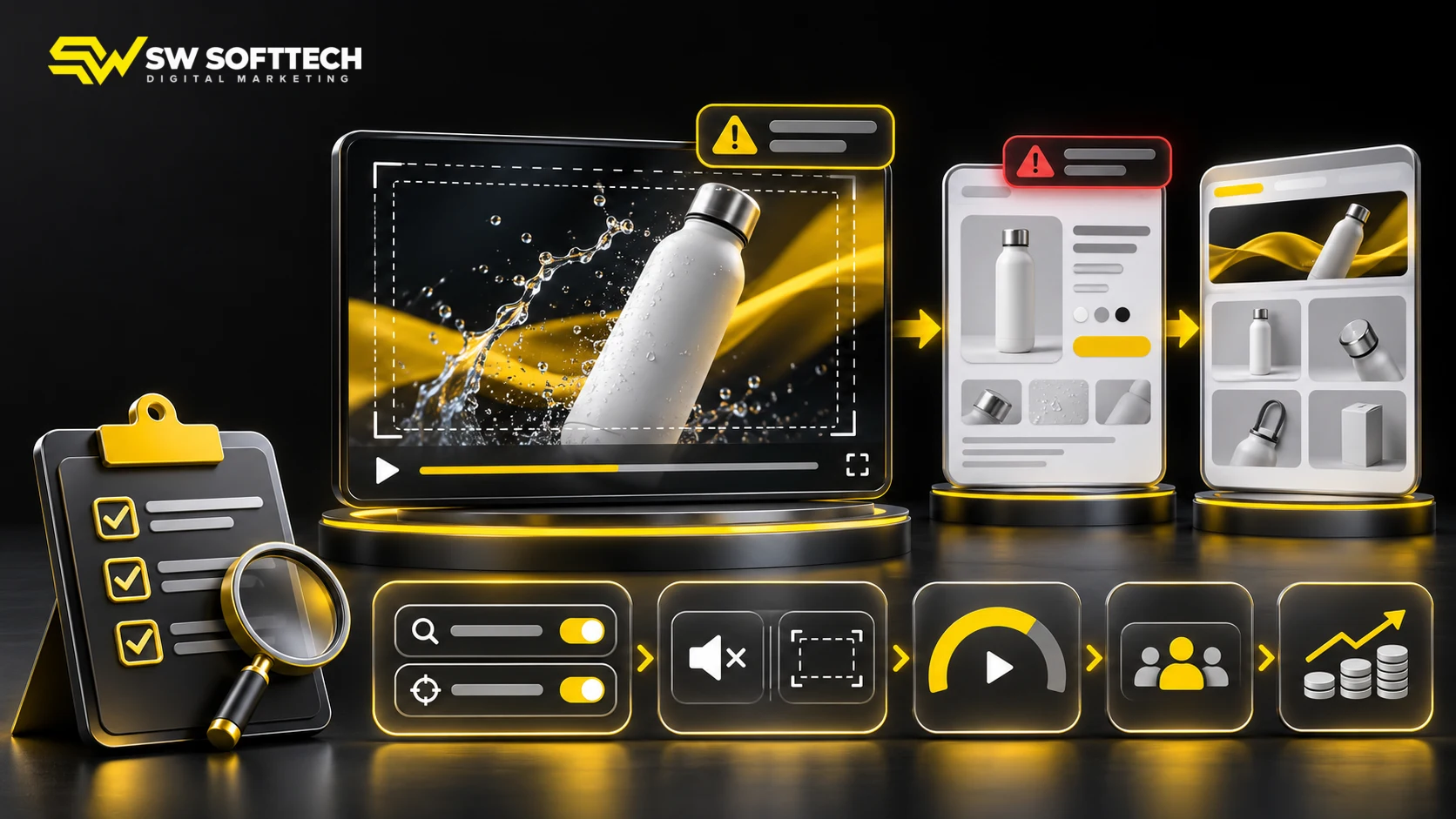
Amazon’s current specification allows videos from six to 45 seconds and recommends 20 seconds or less. Required formats include a 16:9 aspect ratio and approved technical settings. Amazon also warns advertisers to keep important information away from the lower-right safe area, where interface controls can appear.
Because playback begins muted, the first frames must communicate without narration. Show the product or useful action immediately. Use concise on-screen text only when it adds information the shopper cannot understand visually, and make sure the language matches the US marketplace.
A practical 15-second structure
- Opening problem or use: Show the product solving a recognizable need.
- Proof of function: Demonstrate one or two differentiating features.
- Expectation check: Make size, quantity or included components clear.
- Brand and next step: Finish with a clean product or brand frame.
Recommendation: do not turn the video into a miniature product listing. The ad’s job is to earn a relevant visit; the destination must complete the decision.
4. Separate targeting hypotheses
Amazon supports keyword, category and product targeting for Sponsored Brands video. Put materially different hypotheses into separate campaigns or ad groups so the report remains interpretable.
For the bottle example, the team could separate:
- non-branded category searches such as insulated water bottle;
- use-case searches related to commuting or fitness;
- branded searches;
- competing or complementary product-detail targets; and
- category targets refined for relevant price or product attributes.
Do not mix branded demand with broader acquisition and then judge both by one blended ROAS. Brand searches may convert efficiently because the shopper already knows the business, while non-branded campaigns have a harder discovery job.
Review the search term report and add negatives where available, but protect converting queries from broad exclusions. If seasonal demand is material, align inventory and creative timing with the checks in this Black Friday and Cyber Monday planning guide.
5. Measure more than attributed sales
Amazon’s performance-metric documentation distinguishes purchases, sales and ROAS attributed to an ad interaction. It also defines new-to-brand purchases and sales using whether a shopper bought from the brand during the previous 12 months. These are attributed platform metrics; they are not the same as independently proven incremental sales.
For a practical decision report, retain:
- spend, clicks, CPC and click-through rate;
- video completion rate and cost per completed view where available;
- detail-page or Brand Store engagement;
- purchases, sales, ROAS and advertised-product sales;
- new-to-brand purchases, sales and acquisition cost;
- unit margin, discounts, marketplace fees, returns and stock status; and
- branded versus non-branded targeting results.
Amazon announced on May 18, 2026 that category benchmark reporting had become generally available across supported marketplaces, including the US, with video completion and cost-per-completed-view benchmarks among the available metrics. Use benchmarks as context, not as a substitute for the brand’s own margin and growth targets.
6. Test one meaningful change at a time
Recommendation: compare controlled creative or targeting hypotheses instead of changing the video, ASIN, bid and audience together.
Useful tests include:
- product-in-use opening versus feature close-up;
- product-detail destination versus a tightly matched Brand Store page;
- category keyword set versus use-case keyword set; or
- benefit-led demonstration versus comparison-led demonstration that complies with Amazon policy.
Keep the promoted product, budget approach and evaluation period as consistent as practical. Record inventory changes, price promotions, review shifts and retail events that could distort the comparison.
A go/no-go checklist
Launch or scale only when:
- the advertiser and ASIN meet current eligibility requirements;
- the product and destination match every material creative claim;
- the video works without sound and keeps key information inside the safe area;
- targeting hypotheses are separated and exclusions are reviewed;
- branded and non-branded demand are reported separately;
- new-to-brand metrics are evaluated alongside attributed ROAS;
- contribution margin, returns and inventory are included in the decision; and
- the team has a defined action for a strong, weak or inconclusive result.
One limitation matters: Sponsored Brands reporting shows Amazon-attributed outcomes under Amazon’s definitions. It does not prove that every reported purchase happened only because of the ad. Use the platform report, retail economics and structured testing together.
Use SW SOFTTECH’s free marketing action-plan builder to identify three priority improvements, recommended channels and practical next steps, with an optional free consultation. If you need help auditing Sponsored Brands video creative, targeting, ASIN readiness and profitability, explore our Amazon PPC management services and contact SW SOFTTECH to discuss a focused Amazon Ads review.