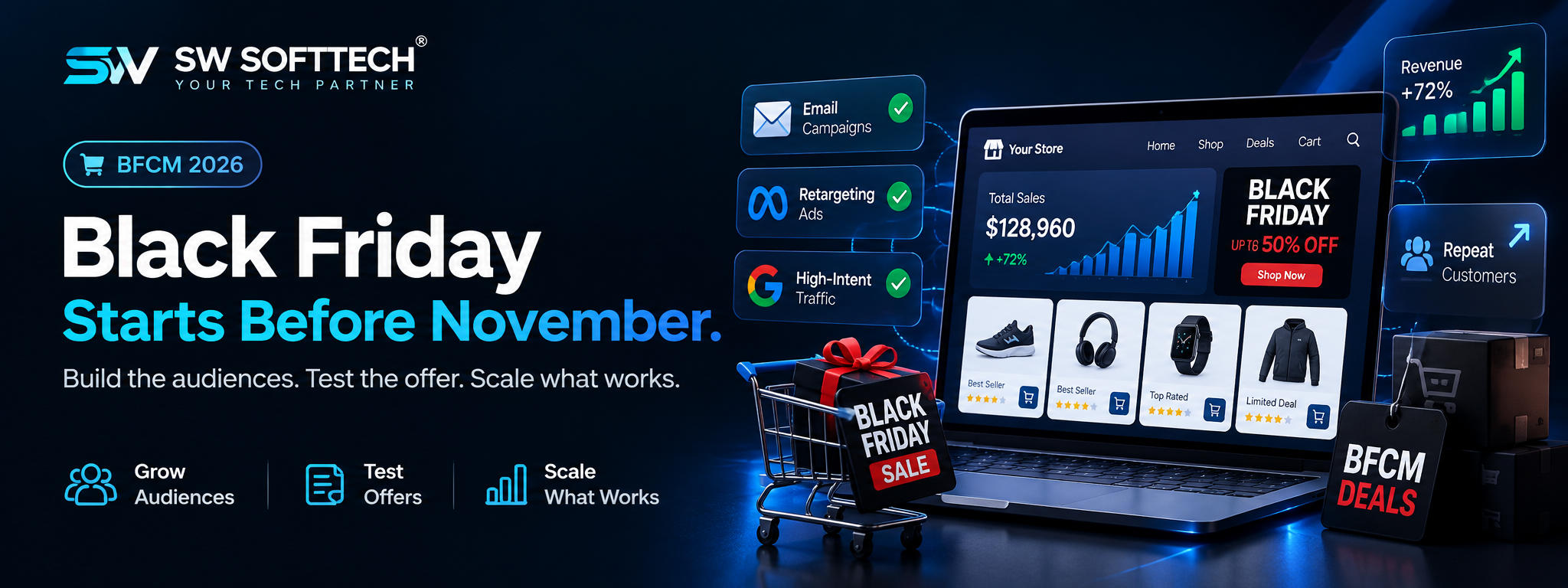
Black Friday is not a November marketing campaign anymore.
For serious eCommerce brands, the work begins weeks—sometimes months—before the sale.
And with Black Friday approaching, October is the point where businesses should be testing offers, building remarketing audiences, improving product feeds and preparing email and advertising campaigns.
Waiting until the week before Black Friday means entering one of the most competitive advertising periods of the year without enough data.
The brands that prepare early have a much better chance of turning the holiday rush into profitable customer acquisition.
Why Black Friday Cyber Monday Still Matters
The scale of online spending continues to make Black Friday Cyber Monday one of the most important periods for eCommerce.
Shopify reports that merchants on its platform generated a record $14.6 billion in sales during the 2025 Black Friday Cyber Monday weekend, representing 27% growth compared with the prior year. More than 81 million customers purchased from Shopify-powered businesses during the period.
That doesn't mean every store automatically wins.
Competition for attention also rises.
CPCs may increase.
Email inboxes become crowded.
Discounts become more aggressive.
Customers compare more offers.
Winning requires more than placing “20% OFF” on the homepage.
1. Start Testing Before November
October should be your testing month.
Test:
- offers
- product bundles
- creative
- landing pages
- email subject lines
- Meta Ads
- Google Shopping campaigns
- audience segments
- remarketing windows
Klaviyo's 2026 BFCM planning guidance recommends using September and October for testing offers and marketing channels before early-access and gift-guide campaigns begin in November.
This gives businesses time to learn before advertising costs reach their seasonal peak.
2. Don't Make Discounting Your Entire Strategy
Black Friday customers expect value.
That does not always require the deepest discount.
Brands can test:
- bundles
- buy-one-get-one offers
- free gifts
- free shipping
- spend-and-save tiers
- loyalty rewards
- exclusive products
- limited-edition launches
- early-access offers
The goal is not simply increasing conversion rate.
Protect margin too.
A campaign that produces huge revenue but little profit isn't automatically a successful campaign.
3. Separate New Customers From Existing Customers
The same offer does not need to go to everyone.
Existing customers already know the brand.
New customers need more trust.
Your marketing can reflect that.
New customers may need:
- reviews
- product demonstrations
- guarantees
- FAQs
- comparison information
- social proof
Existing customers may respond better to:
- VIP access
- loyalty rewards
- personalized recommendations
- complementary products
- bundles
Segmentation usually produces stronger communication than broadcasting one generic message to the entire database.
4. Prepare Google Shopping Early
For eCommerce businesses, Google Shopping can become one of the most valuable BFCM acquisition channels.
Before increasing the budget, review the foundation.
Check:
- product titles
- GTINs
- product categories
- images
- pricing
- promotional feeds
- availability
- Merchant Center warnings
- conversion tracking
- profit margins
A poorly optimized product feed can limit performance regardless of how much advertising budget you add.
Products should also be grouped intelligently.
Separate:
- best sellers
- high-margin products
- clearance
- seasonal inventory
- low-stock products
This allows budgets to reflect commercial priorities rather than treating every SKU equally.
5. Build Meta Remarketing Audiences Now
Many customers who purchase during Black Friday will discover the brand before the actual sale.
October advertising can help fill your remarketing pool.
Build audiences from:
- website visitors
- Instagram engagement
- Facebook engagement
- video viewers
- product viewers
- add-to-cart users
- email subscribers
- existing customers
Then BFCM campaigns can communicate differently with warm prospects and completely new audiences.
The important principle is simple:
Do not start building awareness on the same day you expect the sale.
Our guide to Meta Ads, AI and Advantage+ campaigns in 2026 explains how this automation is changing paid social strategy.
6. Get Email and SMS Ready
Paid ads attract demand.
Owned channels help businesses monetize it efficiently.
Prepare:
- welcome flows
- abandoned-cart sequences
- browse-abandonment emails
- early-access campaigns
- VIP segments
- product recommendations
- countdown messages
- last-chance reminders
- post-purchase follow-up
Klaviyo says more than 15,000 of its customers achieved their best-ever sales day during the previous Black Friday period, and its guidance emphasizes list growth and customer-data activation before peak season.
The takeaway is not that email replaces paid advertising.
The strongest eCommerce strategy uses them together.
7. Create a Retargeting Sequence, Not One Ad
Someone who viewed a product once should not necessarily see the same advertisement 15 times.
Build a progression.
Awareness
Introduce:
- the product
- problem
- use case
- lifestyle benefit
Consideration
Show:
- reviews
- demonstrations
- comparisons
- benefits
- FAQs
Conversion
Use:
- offer
- urgency
- limited inventory
- free shipping
- deadline
Good retargeting moves people forward.
It doesn't simply follow them around.
8. Watch Profitability During the Sale
BFCM dashboards can become addictive.
Revenue rises rapidly.
ROAS looks exciting.
But businesses should monitor:
- contribution margin
- new-customer acquisition cost
- discounts
- shipping cost
- returns
- payment fees
- repeat-purchase rate
- product-level profitability
A $100 order with a 40% discount is not equivalent to a $100 full-price order.
Make sure campaign decisions reflect real economics.
- Black Friday Should Create Customers for December and Beyond
The sale is not over when Cyber Monday ends.
Holiday customers create future marketing opportunities.
Use post-purchase campaigns to:
- collect reviews
- cross-sell products
- offer replenishment
- encourage referrals
- promote gift products
- build loyalty
- introduce subscriptions
Klaviyo's current BFCM strategy guidance describes the period increasingly as a broader acquisition and retention opportunity rather than only a short promotional weekend.
This is where strong CRM and email automation can turn discounted first purchases into profitable longer-term relationships.
Your BFCM Checklist
Before scaling Black Friday advertising, confirm:
- tracking is accurate
- Merchant Center is healthy
- product feeds are optimized
- landing pages work on mobile
- creative has been tested
- offers are financially viable
- email automations are ready
- remarketing audiences are large enough
- customer lists are uploaded
- inventory is available
- budgets are planned
- reporting includes profit—not only revenue
The strongest BFCM campaign is usually built before Black Friday arrives.
Start Preparing Now
Black Friday and Cyber Monday attract enormous demand.
They also attract enormous competition.
Businesses that wait until the final week are forced to make expensive decisions with very little data.
Use October to test.
- Learn what customers respond to.
- Build your audiences.
- Fix tracking.
- Improve product feeds.
- Prepare creative.
Then scale what works when purchase intent rises.
Need Help With Your 2026 Holiday Campaigns?
SW SOFTTECH helps eCommerce brands with Google Shopping Ads, Meta Ads, marketplace PPC, email marketing, conversion optimization and multi-channel eCommerce growth.
If you want a structured Black Friday/Cyber Monday campaign rather than last-minute discount advertising, contact SW SOFTTECH to plan your 2026 holiday marketing strategy.