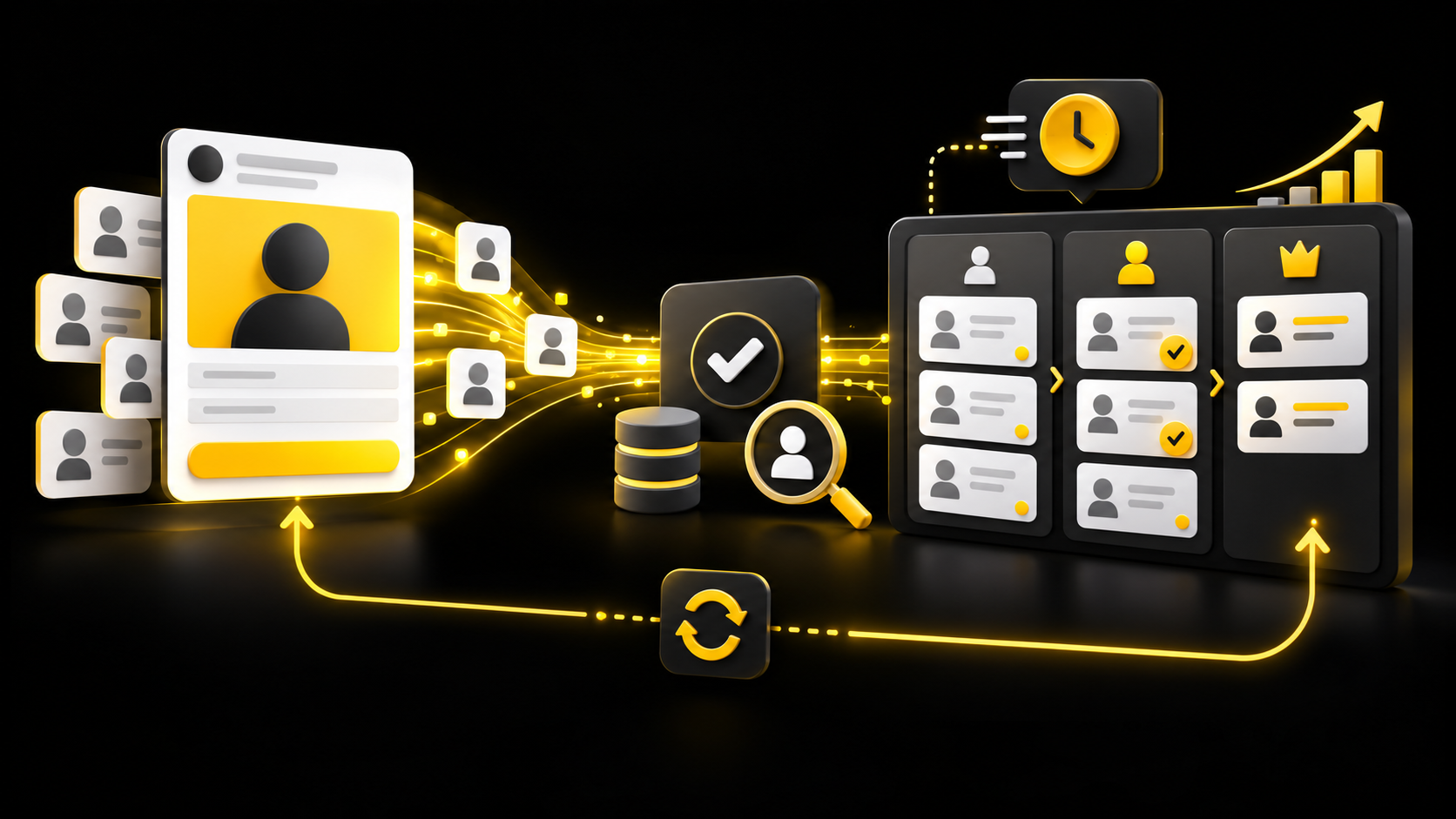
TikTok can produce a lead quickly, but a form submission is only the start. The contact may be unreachable, outside the service area or ready to buy. Treating every submission equally can reward volume while hiding lead quality.
This guide explains a practical TikTok Ads conversion tracking setup for US lead-generation businesses. It connects website or Instant Form activity to the TikTok Pixel, Events API and CRM stages while keeping platform attribution separate from confirmed revenue.
Start with a lead-event ladder
Before installing another tag, define the actions that represent real progress. TikTok’s current standard-event guidance uses Lead for new Pixel setups and also supports events such as StartTrial, SubmitApplication and ApplicationApproval for relevant journeys. TikTok says the older ClickButton event remains supported until 2027, but recommends newer event names for new implementations.
A service business could use this measurement ladder:
| Stage | Example action | Best record |
|---|---|---|
| Interest | Pricing-page or service-page view | Website analytics |
| Enquiry | Accepted website form or TikTok Instant Form | Website/TikTok and CRM |
| Engagement | Call connected or appointment booked | CRM or scheduler |
| Qualification | Suitable need, budget, location and timing | CRM |
| Outcome | Proposal, sale or closed-won value | CRM and finance |
The event names are platform documentation. The ladder is a recommendation: adapt it to how your sales team actually qualifies a prospect.
Choose the correct capture path
TikTok lead campaigns commonly send prospects to a website or keep them inside TikTok with an Instant Form. The measurement workflow differs.
Website lead campaigns
For a website conversion campaign, record a Lead only after the form is accepted successfully—not when somebody clicks the submit button. A click can be followed by validation failure, a server error or abandonment.
TikTok states that a Pixel or Events API setup is required for its Web Conversions objective. The Pixel shares browser events; Events API shares marketing data from web, app, offline or CRM systems. TikTok currently recommends using both for web conversions, with event deduplication when the same conversion is sent twice.
TikTok Instant Forms
An Instant Form can reduce mobile friction, but the lead still needs to reach the business promptly. TikTok’s June 2026 CRM guidance lists direct integrations, third-party tools, custom API with webhooks and website-builder plugins. Its documented benefits include real-time CRM updates and fewer manual-export errors.
Choose the simplest connection your team can operate reliably. Native integrations may be easier to maintain; automation platforms offer flexible routing; custom webhooks provide more control but create engineering and monitoring responsibilities.
Combine Pixel and Events API without double-counting
Browser and server signals can complement each other. Browser events carry page context, while server events can confirm that the business system accepted the action. Sending both does not automatically make the measurement correct.
TikTok’s Events API documentation recommends Pixel plus Events API for web clients. When both send the same conversion, TikTok’s deduplication guidance requires the same event_id on both copies.
For one website enquiry:
- Generate one stable event ID when the server accepts the submission.
- Send the browser Lead event with that ID.
- Send the server Lead event with the same ID.
- Store the ID with the CRM record for troubleshooting.
- Never reuse the ID for a different person or later sales stage.
If the browser sends Lead and the server later sends a distinct QualifiedLead or mapped CRM event, those are different business events; document the definitions rather than trying to deduplicate them as one action.
Connect campaign context to CRM quality
The CRM should retain the original source, campaign, ad or creative identifiers available through the approved integration, plus the landing page, submission time, lead owner and lifecycle stage. Do not place sensitive form answers in URLs or analytics parameters.
Consider a hypothetical HVAC company advertising in Texas. The form completion is a lead, but the CRM may later show that the prospect lives outside the service area. A second prospect may book an estimate and receive a qualified status. Those outcomes should appear separately in the internal scorecard even if the ad platform attributes both form submissions to TikTok.
The CRM lead follow-up automation guide covers assignment, acknowledgement, booking and failure handling. The GA4 lead tracking guide explains how to keep website actions distinct from qualified outcomes. For a comparable paid-social workflow, see the Meta Lead Ads and CRM guide.
Protect customer data
Server-side measurement is not permission to send every CRM field to an advertising platform. TikTok’s setup instructions tell advertisers to define events, parameters and match keys with marketing, legal and technical teams and review its privacy and data-use terms.
Create a field-level data map showing what is collected, why it is needed and who can access it. Send only approved data needed for measurement, honor applicable choices, and keep access tokens out of client-side code and routine reports.
Test the full journey before spending more
TikTok Events Manager diagnostics can show event type, connection method, matching and deduplication information, recent activity and diagnostic issues. Its Test Events area separates browser and server activity.
Run these checks with test records clearly marked:
- complete the journey on a real phone from ad or landing page to confirmation;
- verify that a failed form does not fire Lead;
- confirm one browser event and one server event share the same event ID;
- check that an Instant Form reaches the correct CRM pipeline and owner;
- confirm timestamps, time zones and campaign fields are preserved;
- move a test lead through qualification and verify later-stage logic;
- test duplicate submissions, spam filtering and integration failure alerts;
- remove or exclude test records from business reporting.
Do not rely only on a tag helper. A received event may still represent the wrong action, contain weak matching data or fail to reach sales.
Report lead quality beside platform attribution
A useful weekly view includes:
- spend, impressions, clicks and landing-page sessions;
- accepted leads and cost per lead;
- contactable leads and booked appointments;
- qualified leads and cost per qualified lead;
- opportunities, sales and recorded value;
- duplicate, spam, rejected and unmatched events;
- time from submission to first human response;
- results by campaign, creative, geography and capture method.
TikTok Ads Manager applies TikTok’s attribution rules; CRM and finance systems record internal business states. Attribution windows, matching, consent, delayed sales updates and other touches can create differences. Reconcile trends and identifiable gaps; do not force every total to match.
A practical implementation order
- Define lead, booked, qualified and sale stages with sales.
- Choose website conversion, Instant Form or a controlled test of both.
- Configure Pixel and confirmed-success events.
- Add Events API with consistent event IDs and documented deduplication.
- Route leads to the CRM with ownership and failure alerts.
- Validate browser, server and CRM behavior in Events Manager.
- Review cost per qualified lead before increasing budget.
The practical takeaway: optimize toward the strongest trustworthy event you can collect consistently. Better tracking cannot repair weak creative, targeting, offers or sales follow-up, but it can show where the lead journey is breaking.
You can build a free marketing action plan with three priority improvements, recommended channels and practical next steps, plus a free consultation.
Want a structured review of TikTok Ads, conversion tracking and CRM lead quality? Discuss paid social and conversion measurement with SW SOFTTECH. Share your campaign objective, lead-capture method and CRM so the consultation can focus on the most important gaps.
Primary TikTok documentation checked October 19, 2026. Platform interfaces, integrations and event requirements can change. This guidance does not guarantee lead volume, attribution accuracy or advertising performance.