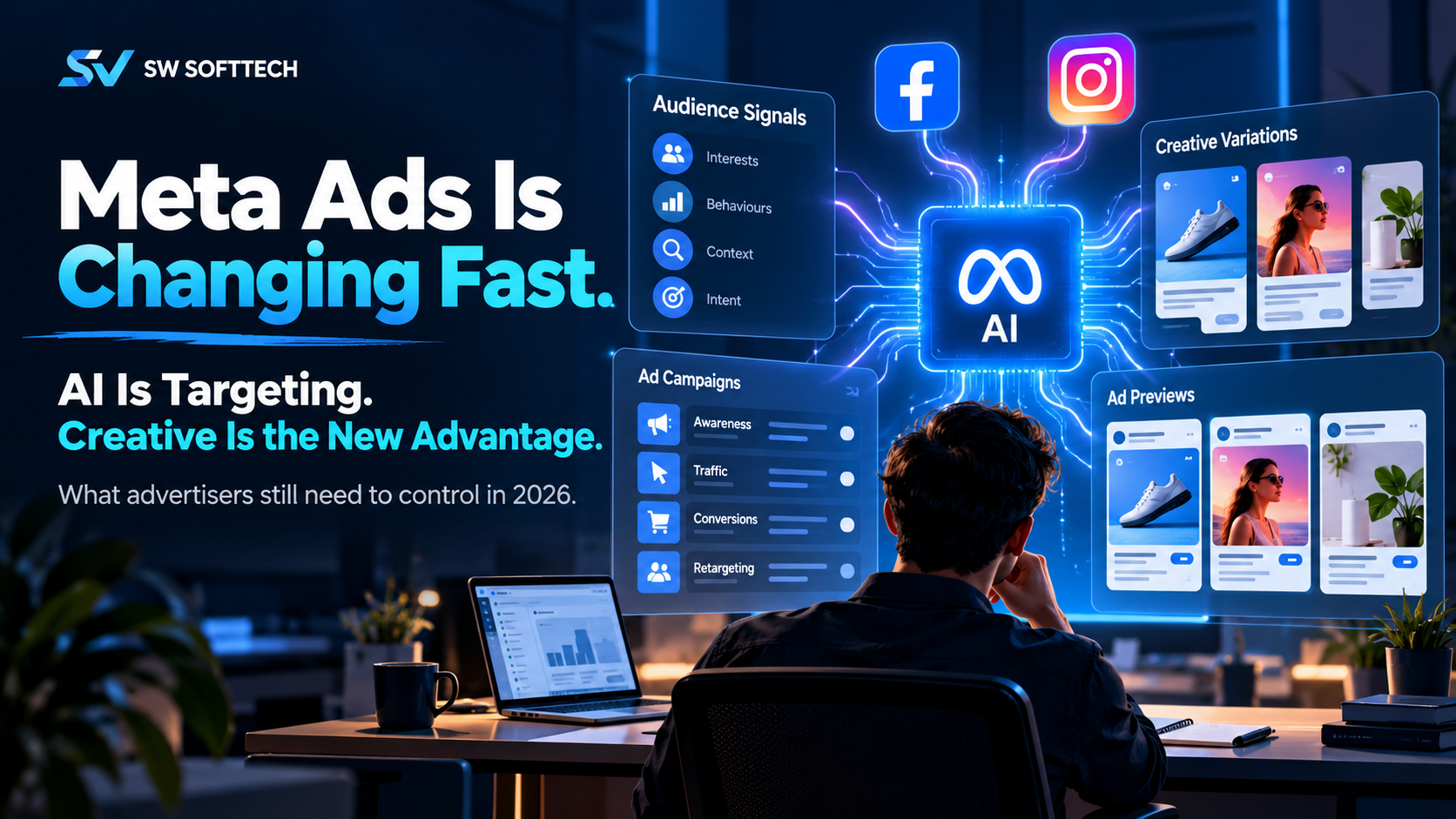
Facebook and Instagram advertising are becoming less about manually choosing every audience setting and more about giving Meta's AI enough information to find the right customer.
That shift has been developing for several years.
In 2027, it is accelerating.
- Meta is investing heavily in:
- AI-powered ad ranking
- automated audience discovery
- Advantage+ campaigns
- generative creative
- conversion modeling
- business AI
- messaging automation
For advertisers, this creates both an opportunity and a risk.
The opportunity is greater scale with less manual campaign complexity.
The risk is assuming AI can compensate for weak strategy.
It can't.
How AI Is Changing Meta Ads
Meta's advertising platform has always used machine learning.
What's different now is the scale.
Meta said its newer advertising models improved ad selection and personalization across Facebook and Instagram. In its January 2026 update, the company reported that several ranking improvements introduced during Q4 2025 increased ad clicks and conversions within its own tests and platform data.
Those are Meta's own reported results—not a guarantee for every advertiser.
But they show the direction clearly.
Meta wants advertisers to rely more heavily on AI for:
- who sees an ad,
- which creative they see,
- when they see it,
- and where it appears.
What Is Meta Advantage+?
Advantage+ is Meta's collection of AI-powered advertising tools designed to simplify campaign setup and allow the system to optimize targeting, placements and delivery.
Instead of creating dozens of tightly restricted audiences, businesses can increasingly provide Meta with:
- their offer
- creative assets
- conversion objective
- customer data
- budget
- campaign restrictions
and allow the system to find likely converters.
Meta says nearly all of its advertisers already use at least one AI-driven product from its advertising portfolio.
Does Detailed Audience Targeting Still Matter?
Yes—but differently.
The old Facebook Ads playbook often looked like this:
- Create ten interests.
- Stack behavioral targeting.
- Add demographic restrictions.
- Split everything into multiple ad sets.
- Then manually shift budget between them.
That approach can still be useful in specific situations.
But modern Meta Ads increasingly reward strong signals and strong creative rather than endless audience micromanagement.
The algorithm needs room to learn.
That doesn't mean:
“Target everyone and hope.”
It means marketers need to concentrate more on:
- customer data
- conversion quality
- creative diversity
- offer strength
- landing-page performance
- exclusions
- geographic constraints
- funnel design
Creative Is Becoming the Targeting
One of the biggest shifts in Meta advertising is the importance of creative variation.
Two people in the same broad audience may respond to completely different messages.
For example, a medical spa campaign might use:
- Creative A: transformation/result focused
- Creative B: problem/education focused
- Creative C: trust and practitioner credibility
- Creative D: introductory offer
- Creative E: testimonial/social proof
That testing becomes even more important when preparing campaigns for Black Friday and Cyber Monday.
Meta can learn which message resonates with different people.
That means successful paid-social teams need a continuous creative-testing system.
Running one ad for three months is rarely enough.
AI Doesn't Fix a Weak Offer
This is one of the most important principles in performance marketing.
If customers don't want the offer, more automation won't solve the problem.
AI can improve delivery.
It cannot magically turn this:
“Contact us to learn more.”
into a compelling reason to act.
Good campaigns still need:
- a clear problem
- a relevant solution
- a strong value proposition
- credibility
- a reason to respond now
- frictionless conversion
Before blaming Meta Ads, inspect the offer.
Lead Generation: Optimize Beyond the Form
A common Meta Ads mistake is judging success by cost per lead alone.
Suppose Campaign A generates:
100 leads at $10 each.
Campaign B generates:
50 leads at $20 each.
Campaign A looks better.
But what happens if Campaign B produces three times as many paying customers?
That's why serious Meta Ads management should connect advertising with CRM and sales outcomes.
Track:
- contact rate
- qualified lead rate
- booked appointments
- show rate
- close rate
- customer acquisition cost
- revenue
Cheap leads are useful only when they become valuable customers.
Messaging Is Becoming More Important
Meta is also placing significant investment behind messaging-driven commerce and customer conversations.
The company said click-to-message ad revenue growth in the U.S. exceeded 50% year over year in Q4 2025, while WhatsApp business messaging continued to expand.
For some businesses, the best conversion may no longer be:
Ad → landing page → long form
It may be:
Ad → WhatsApp/Messenger → conversation → qualification → appointment
This can be particularly effective where customers have questions before buying.
Meta Is Expanding AI Beyond Ads
The broader direction became even clearer at the end of September 2026.
Meta announced Muse for Small Business, designed to connect with business tools including Shopify, Klaviyo, HighLevel and Facebook/Instagram business accounts.
Meta says actions such as publishing, sending or spending still require business approval.
This shows where small-business marketing technology is heading:
AI will increasingly connect advertising, CRM, messaging, content and operational data.
That makes integration strategy more valuable—not less.
What Businesses Should Control
Even as Meta automates more advertising decisions, businesses should retain strategic control over:
Conversion events
Make sure Meta is optimizing toward actions that actually matter.
Customer data
High-quality first-party data can help improve targeting and measurement.
Creative strategy
Give the algorithm multiple strong ideas to work with.
Offers
Your promotion or value proposition still determines whether people care.
CRM follow-up
Leads lose value quickly when sales teams respond slowly.
Measurement
Track business results instead of celebrating vanity metrics.
Should You Use Meta Ads Automation?
In most accounts, yes—but test intelligently.
Automation should reduce unnecessary manual work.
It should not remove accountability.
The advertiser still needs to ask:
- Are we reaching the right customers?
- Are the leads qualified?
- Are sales improving?
- Is customer acquisition profitable?
Those are business questions, not algorithm settings.
Need Help With Facebook and Instagram Advertising?
SW SOFTTECH provides Meta Ads management, Facebook lead generation, Instagram advertising, conversion tracking and CRM-integrated marketing campaigns.