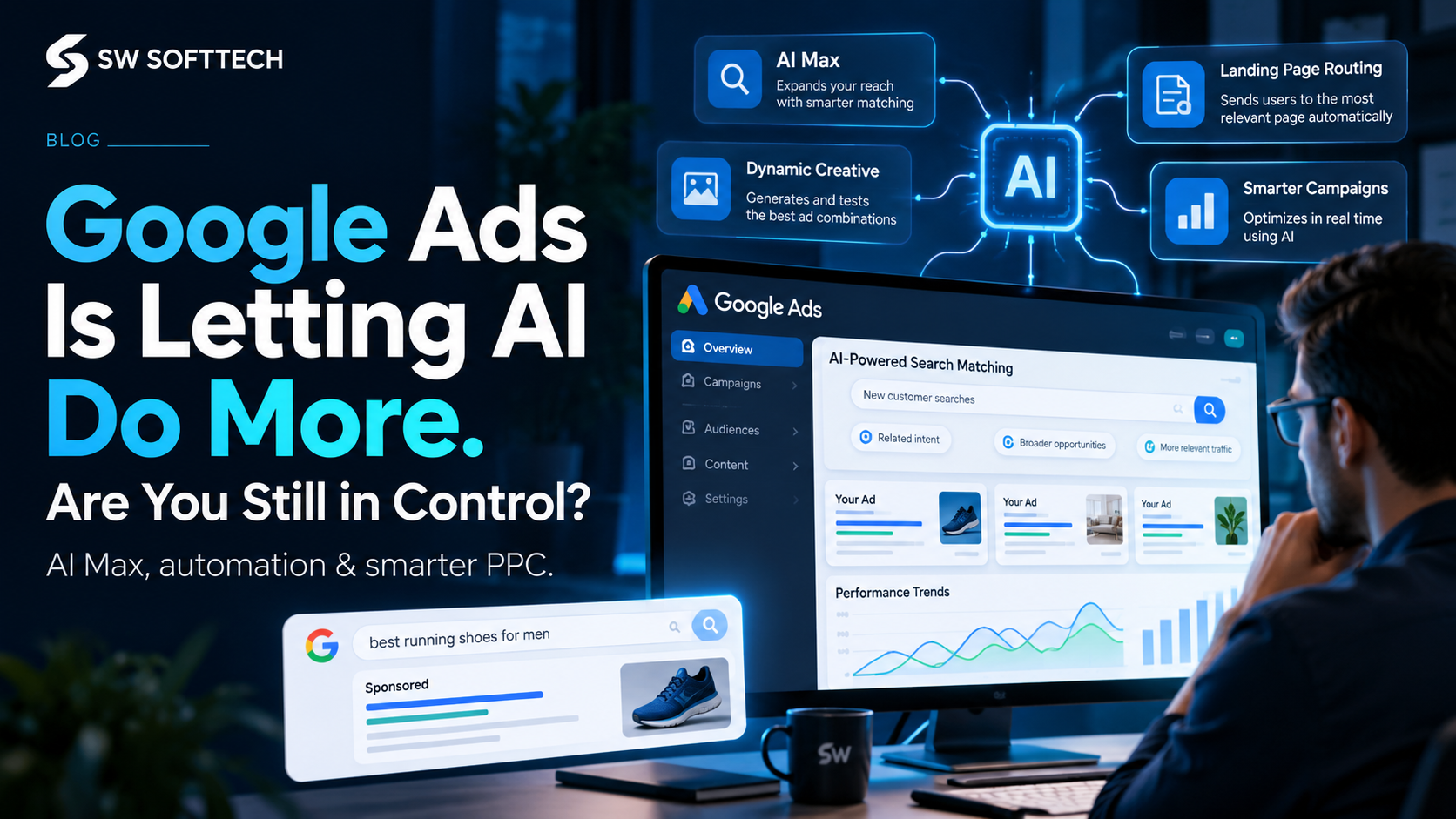
Google Ads is becoming significantly more automated.
That isn't a prediction.
It is already happening.
Bidding has become automated.
Search matching is increasingly AI-driven.
Creative can be generated or adapted automatically.
Google can even decide which landing page to send a potential customer to.
One of the clearest examples of this shift is Google Ads AI Max.
For businesses using paid search, the important question is no longer:
“Should we use automation?”
It is:
“What should we automate—and what still requires human marketing judgment?”
What Is Google Ads AI Max?
AI Max is an AI-powered optimization layer for Google Search campaigns.
It is designed to help advertisers discover additional relevant searches, adapt messaging and improve campaign performance beyond the exact keywords and ads manually entered into an account.
AI Max can combine:
- AI-powered search-term matching
- broad match technology
- keywordless targeting
- text customization
- Final URL Expansion
- brand controls
- geographic intent controls
- reporting and campaign insights
Google is steadily moving more Search functionality into AI Max.
Campaigns using Automatically Created Assets and campaign-level broad-match settings began automatic upgrades from September 2026, while the automatic Dynamic Search Ads transition has been moved to February 2027.
Google Is Giving Advertisers More AI—And More Visibility Into It
One problem with advertising automation has always been transparency.
If Google chooses:
- the search
- the ad combination
- the bid
- and the landing page
advertisers naturally want to know what actually happened.
On September 23, 2026, Google announced a new AI Max reporting experience designed to show the Search journey in one place.
Advertisers will be able to see:
- which search term triggered the ad
- which creative assets were shown
- where the visitor landed on the website
Google says additional availability information will be released later in 2026.
That is an important step because automation without visibility makes strategic optimization difficult.
Should Businesses Use Google Ads Automation?
In many cases, yes.
AI can process far more combinations and signals than a human campaign manager can manually evaluate.
It may identify valuable search opportunities marketers did not anticipate.
But automation performs best when the business gives it the right information.
Think of Google Ads AI as a very fast optimizer.
It can optimize aggressively toward the goal you provide.
The challenge is making sure you gave it the right goal.
A Cheap Lead Is Not Always a Good Lead
Imagine two groups of leads.
Lead Type A
Cost per lead: $30
Sales close rate: 3%
Lead Type B
Cost per lead: $80
Sales close rate: 25%
If Google only understands lead-form submissions, Lead Type A may look significantly better.
But the business may make substantially more money from Lead Type B.
This is where many Google Ads accounts fail.
The campaign is technically “optimized.”
But it is optimized toward an incomplete business signal.
That's why modern PPC management needs more than bidding knowledge.
It needs:
- accurate conversion tracking
- CRM integration
- offline conversion imports
- qualified-lead tracking
- revenue tracking
- profit data
- lifetime-value information
What Should Google Automate?
Businesses should allow automation to help with areas where machine learning has a clear advantage.
Search discovery
AI can identify relevant query variations that would be difficult to capture manually.
Bidding
Automated bidding can respond to many real-time signals and adjust auction decisions at scale.
Creative testing
AI can help match different assets and messages with different search contexts.
Landing-page matching
For businesses with well-structured websites, Final URL Expansion may help connect visitors with more relevant pages.
What Should Marketers Still Control?
This is where strategy matters.
1. Conversion tracking
Bad tracking creates bad optimization.
Before scaling automation, confirm that important business outcomes are being measured correctly.
2. Lead quality
Do not evaluate PPC only by cost per lead.
Track:
- qualified leads
- booked calls
- opportunities
- customers
- revenue
3. Negative keywords and exclusions
Automation should not mean accepting irrelevant traffic.
Search-term analysis is still essential.
4. Landing-page quality
Google may decide which page to show.
It cannot fix:
- a confusing offer
- poor mobile UX
- slow loading
- weak trust signals
- unclear pricing
- bad forms
5. Business economics
Google understands advertising data.
You understand—or should understand—your margins, sales cycle, lifetime value and profitability.
Those business realities should determine acceptable CPA and ROAS targets.
Why PPC Management Is Becoming More Strategic
Some people assume AI will eliminate the need for Google Ads specialists.
I think it changes the job instead. The same shift toward AI-led delivery is also happening across Meta Ads and Advantage+ campaigns.
Less value comes from manually changing dozens of tiny bids.
More value comes from understanding:
- customer acquisition economics
- attribution
- conversion data
- creative strategy
- landing-page optimization
- offer positioning
- experimentation
- CRM feedback
AI can operate the machine.
Someone still needs to decide where the machine should go.
Should You Turn AI Max On?
There isn't one universal answer.
Test it.
Evaluate:
- conversion volume
- qualified-lead rate
- search-term relevance
- CPA
- ROAS
- sales revenue
- landing-page behavior
Do not judge the test after a handful of clicks.
And don't judge success only inside Google Ads.
The real result lives in your CRM and revenue data.
The Future of Google Ads Is AI-Assisted, Not Strategy-Free
Google Ads will almost certainly continue becoming more automated.
Advertisers who resist every form of automation may lose efficiency.
Advertisers who blindly enable every automated feature may lose control.
The better approach sits between those extremes.
Use AI where it is strong.
Build guardrails.
Feed it better data.
And measure what actually reaches the bottom line.
Looking for Better Google Ads Performance?
SW SOFTTECH provides Google Ads management, PPC optimization, conversion tracking and performance marketing services for businesses looking to generate more qualified leads and profitable sales.
If your Google Ads account is spending budget without generating enough business—or you want an expert review before expanding AI-powered campaigns—contact SW SOFTTECH for a Google Ads audit.